> ## Documentation Index
> Fetch the complete documentation index at: https://pulse-hook.mintlify.site/llms.txt
> Use this file to discover all available pages before exploring further.
# Penalty Curve
Penalty-curve model enables dynamic fees in step 5. It is the part where MEV bots really receive what they deserve.
The hook charges every swap a small baseline fee (0.1%), plus an extra penalty if the swap's priority fee is unusually high compared to the recent reference median. The penalty only kicks in past a threshold, then grows smoothly up to a hard cap.
To decide the penalty, the hook first computes the ratio of the swap's priority fee to the reference median priority fee. If that ratio is above **2.7x**, the penalty kicks in (see [The formula](#the-formula) below for the exact math).
Check the table below to see what ratio will result in what total fee.
| Ratio | Basic Fee | Penalty Part | Total Fee |
| ---------- | --------- | ------------ | ---------- |
| **≤ 2.7x** | 0.1% | 0% | 0.1% |
| **\~4-5x** | 0.1% | \~1-2% | \~1.1-2.1% |
| **\~7x** | 0.1% | \~3-5% | \~3.1-5.1% |
| **10x** | 0.1% | 10% (capped) | 10.1% |
| **20x** | 0.1% | 10% (capped) | 10.1% |
**So the penalty curve looks like this:**
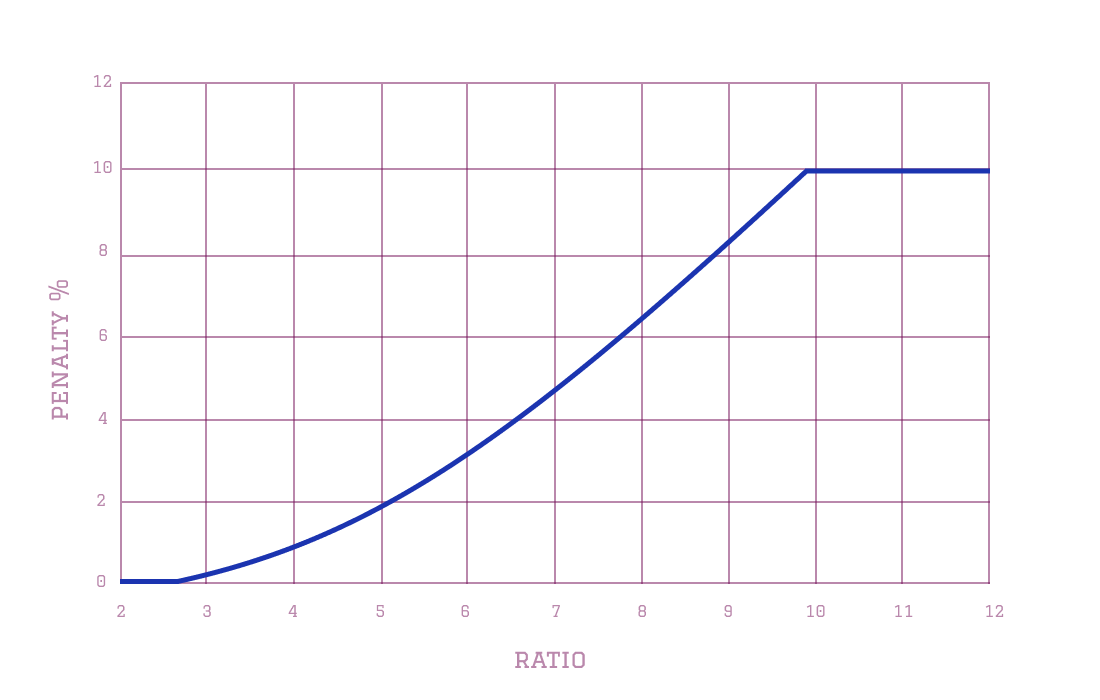
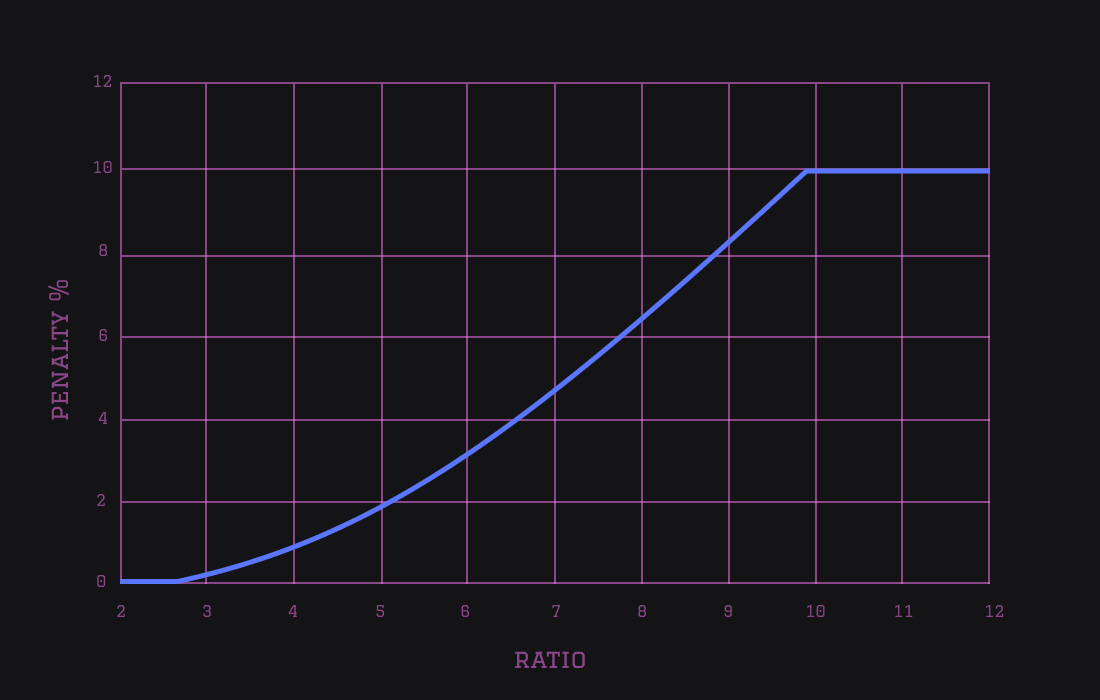 We can see it is 1.5 curve that has delayed start and has a strict 10% penalty cap.
## Design questions
2
1
3
## The formula
The curve is computed on-chain with the formula below, using OpenZeppelin's `Math` library.
```text theme={null}
r = priority_fee / M // M = reference median priority fee
f(r) = min((r - 2.7) / 7.3, 1) // 2.7 = threshold, 7.3 = saturation range
penalty(r) = 0 if r < 2.7
penalty(r) = 10% * f(r)^1.5 if r >= 2.7
fee = 0.1% + penalty(r) // 0.1% = basic fee
```
### Why `frac^1.5` and not a "real" power function
Solidity has no cheap general `pow` for fractional exponents. But `frac^1.5` can be rewritten as:
```text theme={null}
frac^1.5 = frac * frac^0.5 = frac * sqrt(frac)
```
and `sqrt` is cheap on-chain via `Math.sqrt`. So the whole curve costs one multiplication and one integer square root, with no fixed-point `ln` / `exp` / `pow` library needed.
### Constants
| Constant | Value | Meaning |
| --------------------- | -------- | --------------------------------------------------------------------- |
| `PRECISION` | 1000 | Fixed-point scale for the ratio (`1000` = 1.0x) |
| `WAD` | 1e18 | Fixed-point scale for the `frac^1.5` calculation |
| `RATIO_THRESHOLD` | 2700 | Penalty starts at 2.7x the reference median |
| `D_CAP` | 7300 | Width of the penalty range; penalty saturates at `2.7x + 7.3 = 10.0x` |
| `BASIC_FEE` | 1000 ppm | Baseline fee, 0.1%, always charged |
| `MAX_PENALTY_PERCENT` | 10 | Hard cap on the penalty, reached exactly at 10x |
| `PENALTY_UNIT` | 10000 | Converts a plain percent into ppm (1% = 10,000 ppm) |
### Formula → code mapping
| Formula | Code |
| ------------------------------ | ------------------------ |
| `r` (scaled by 1000) | `priorityFeeRatioScaled` |
| `2.7` threshold | `RATIO_THRESHOLD = 2700` |
| `r - 2.7` | `excessRatioScaled` |
| `7.3` saturation range | `D_CAP = 7300` |
| `f(r)`, in WAD | `fracWad` |
| `sqrt(f(r))` | `sqrtFracWad` |
| `f(r)^1.5 = f(r) * sqrt(f(r))` | `frac1_5Wad` |
| `10% * f(r)^1.5`, in ppm | `penaltyPpm` |
| `fee` | `totalFee` |
### How this looks in the code
All fixed-point math here uses two scales: `PRECISION = 1000` for the ratio (so `2700` means "2.7x"), and `WAD = 1e18` for the fractional-exponent part.
```solidity theme={null}
function getDynamicFee_(uint256 priorityFee, int256 referenceMedian) internal virtual returns (uint24) {
// No reference data yet, fall back to the baseline fee to avoid
// dividing by zero (mirrors the old medianPriorityFee == 0 check).
if (referenceMedian <= 0) return BASIC_FEE;
uint256 medianPriorityFee = uint256(referenceMedian);
// How many times (scaled by PRECISION) this swap's priority fee
// exceeds the smoothed reference. E.g. 2700 means "2.7x the
// reference".
uint256 priorityFeeRatioScaled = (priorityFee * PRECISION) / medianPriorityFee;
uint256 penaltyPpm;
if (priorityFeeRatioScaled < RATIO_THRESHOLD) {
// Priority fee is within the tolerated range, no penalty.
penaltyPpm = 0;
} else {
// How far above the threshold this swap's ratio is, scaled by
// PRECISION (e.g. ratio 3.7 with threshold 2.7 gives an
// excess of 1.0 * PRECISION).
uint256 excessRatioScaled = priorityFeeRatioScaled - RATIO_THRESHOLD;
// Fraction of the way through the penalty range [0, D_CAP],
// expressed in WAD (1e18 = "fully saturated"). Clamped to
// WAD instead of computed further once excess reaches D_CAP,
// both to save gas and to guarantee no overflow regardless
// of how large priorityFeeRatioScaled is.
uint256 fracWad = excessRatioScaled >= D_CAP ? WAD : (excessRatioScaled * WAD) / D_CAP;
// frac^1.5 = frac * sqrt(frac), computed in WAD fixed point.
// Math.sqrt(fracWad * WAD) rescales sqrt(x/1e18) back to a
// 1e18-scaled result (sqrt(1e36) == 1e18).
uint256 sqrtFracWad = Math.sqrt(fracWad * WAD);
uint256 frac1_5Wad = (fracWad * sqrtFracWad) / WAD;
penaltyPpm = (frac1_5Wad * MAX_PENALTY_PERCENT * PENALTY_UNIT) / WAD;
}
// Final fee = baseline fee + penalty, in ppm.
uint24 totalFee = BASIC_FEE + penaltyPpm.toUint24();
return totalFee;
}
```
### Notes
* **`M` (reference median)** is a smoothed value, not the live running median directly — see \[link] for how it's derived.
* **Edge case:** if `referenceMedian <= 0` (no data yet), `getDynamicFee_` returns `BASIC_FEE` directly, skipping the ratio/penalty calculation to avoid division by zero.
## Key takeaway
* Every swap pays a flat 0.1% baseline.
* Nothing extra is charged until the priority fee is 2.7x the reference median.
* Above that, a smooth `frac^1.5` curve adds up to 10% more, saturating at 10x.
* The whole thing is computed with one multiplication and one `Math.sqrt`, cheap enough to run on every swap.
We can see it is 1.5 curve that has delayed start and has a strict 10% penalty cap.
## Design questions
2
1
3
## The formula
The curve is computed on-chain with the formula below, using OpenZeppelin's `Math` library.
```text theme={null}
r = priority_fee / M // M = reference median priority fee
f(r) = min((r - 2.7) / 7.3, 1) // 2.7 = threshold, 7.3 = saturation range
penalty(r) = 0 if r < 2.7
penalty(r) = 10% * f(r)^1.5 if r >= 2.7
fee = 0.1% + penalty(r) // 0.1% = basic fee
```
### Why `frac^1.5` and not a "real" power function
Solidity has no cheap general `pow` for fractional exponents. But `frac^1.5` can be rewritten as:
```text theme={null}
frac^1.5 = frac * frac^0.5 = frac * sqrt(frac)
```
and `sqrt` is cheap on-chain via `Math.sqrt`. So the whole curve costs one multiplication and one integer square root, with no fixed-point `ln` / `exp` / `pow` library needed.
### Constants
| Constant | Value | Meaning |
| --------------------- | -------- | --------------------------------------------------------------------- |
| `PRECISION` | 1000 | Fixed-point scale for the ratio (`1000` = 1.0x) |
| `WAD` | 1e18 | Fixed-point scale for the `frac^1.5` calculation |
| `RATIO_THRESHOLD` | 2700 | Penalty starts at 2.7x the reference median |
| `D_CAP` | 7300 | Width of the penalty range; penalty saturates at `2.7x + 7.3 = 10.0x` |
| `BASIC_FEE` | 1000 ppm | Baseline fee, 0.1%, always charged |
| `MAX_PENALTY_PERCENT` | 10 | Hard cap on the penalty, reached exactly at 10x |
| `PENALTY_UNIT` | 10000 | Converts a plain percent into ppm (1% = 10,000 ppm) |
### Formula → code mapping
| Formula | Code |
| ------------------------------ | ------------------------ |
| `r` (scaled by 1000) | `priorityFeeRatioScaled` |
| `2.7` threshold | `RATIO_THRESHOLD = 2700` |
| `r - 2.7` | `excessRatioScaled` |
| `7.3` saturation range | `D_CAP = 7300` |
| `f(r)`, in WAD | `fracWad` |
| `sqrt(f(r))` | `sqrtFracWad` |
| `f(r)^1.5 = f(r) * sqrt(f(r))` | `frac1_5Wad` |
| `10% * f(r)^1.5`, in ppm | `penaltyPpm` |
| `fee` | `totalFee` |
### How this looks in the code
All fixed-point math here uses two scales: `PRECISION = 1000` for the ratio (so `2700` means "2.7x"), and `WAD = 1e18` for the fractional-exponent part.
```solidity theme={null}
function getDynamicFee_(uint256 priorityFee, int256 referenceMedian) internal virtual returns (uint24) {
// No reference data yet, fall back to the baseline fee to avoid
// dividing by zero (mirrors the old medianPriorityFee == 0 check).
if (referenceMedian <= 0) return BASIC_FEE;
uint256 medianPriorityFee = uint256(referenceMedian);
// How many times (scaled by PRECISION) this swap's priority fee
// exceeds the smoothed reference. E.g. 2700 means "2.7x the
// reference".
uint256 priorityFeeRatioScaled = (priorityFee * PRECISION) / medianPriorityFee;
uint256 penaltyPpm;
if (priorityFeeRatioScaled < RATIO_THRESHOLD) {
// Priority fee is within the tolerated range, no penalty.
penaltyPpm = 0;
} else {
// How far above the threshold this swap's ratio is, scaled by
// PRECISION (e.g. ratio 3.7 with threshold 2.7 gives an
// excess of 1.0 * PRECISION).
uint256 excessRatioScaled = priorityFeeRatioScaled - RATIO_THRESHOLD;
// Fraction of the way through the penalty range [0, D_CAP],
// expressed in WAD (1e18 = "fully saturated"). Clamped to
// WAD instead of computed further once excess reaches D_CAP,
// both to save gas and to guarantee no overflow regardless
// of how large priorityFeeRatioScaled is.
uint256 fracWad = excessRatioScaled >= D_CAP ? WAD : (excessRatioScaled * WAD) / D_CAP;
// frac^1.5 = frac * sqrt(frac), computed in WAD fixed point.
// Math.sqrt(fracWad * WAD) rescales sqrt(x/1e18) back to a
// 1e18-scaled result (sqrt(1e36) == 1e18).
uint256 sqrtFracWad = Math.sqrt(fracWad * WAD);
uint256 frac1_5Wad = (fracWad * sqrtFracWad) / WAD;
penaltyPpm = (frac1_5Wad * MAX_PENALTY_PERCENT * PENALTY_UNIT) / WAD;
}
// Final fee = baseline fee + penalty, in ppm.
uint24 totalFee = BASIC_FEE + penaltyPpm.toUint24();
return totalFee;
}
```
### Notes
* **`M` (reference median)** is a smoothed value, not the live running median directly — see \[link] for how it's derived.
* **Edge case:** if `referenceMedian <= 0` (no data yet), `getDynamicFee_` returns `BASIC_FEE` directly, skipping the ratio/penalty calculation to avoid division by zero.
## Key takeaway
* Every swap pays a flat 0.1% baseline.
* Nothing extra is charged until the priority fee is 2.7x the reference median.
* Above that, a smooth `frac^1.5` curve adds up to 10% more, saturating at 10x.
* The whole thing is computed with one multiplication and one `Math.sqrt`, cheap enough to run on every swap.